Theobroma cacao. Food of the gods, grown in a belt twenty degrees wide.
Everything downstream — the price, the balance, the shortfall — starts with a pod on a tree. This is what that pod is, what is inside it, and why so little of it becomes chocolate.
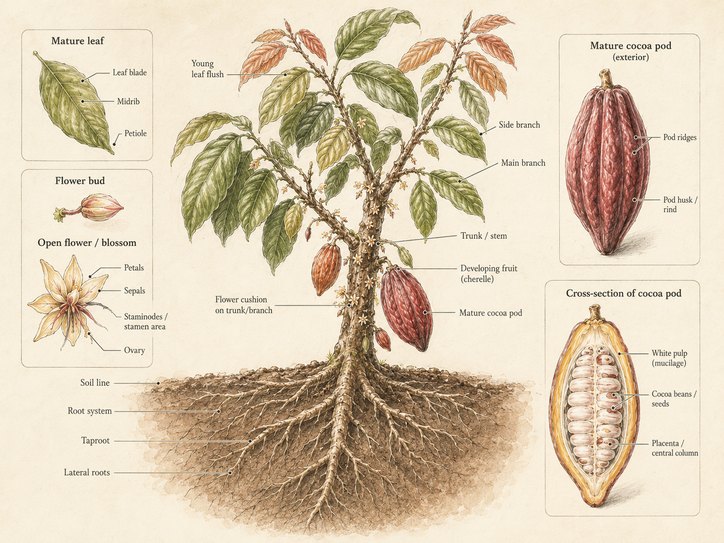
The plant
Click a numbered marker, or pick from the list below. Use the zoom buttons or double-click the plate to look closer.
Where it grows, and why only there
Cacao is an understorey tree from the Amazon basin, and it still behaves like one. It needs a narrow set of conditions, which is why production concentrates in a thin band either side of the equator.
- Within about 20° of the equator, and below roughly 300 m.
- 1,500–2,000 mm of rain a year, spread rather than concentrated. A dry spell of more than three months is a problem.
- 18–32 °C, with no frost, ever.
- Shade when young — full sun kills seedlings, which is why cocoa is grown under taller trees and why removing that canopy raises yield in the short run and risk in the long run.
- Deep, well-drained soil. Waterlogging kills roots quickly.
Those requirements overlap almost exactly with tropical forest, which is why the crop and deforestation are so hard to separate — and why the EU's rules on deforestation-free imports land on cocoa harder than on most commodities.
The season, and why the crop is not one harvest
West Africa runs two crops from the same trees. The main crop runs roughly October to March and carries most of the volume and the better bean size. The mid-crop, April to September, is smaller, and its beans usually attract a discount.
Flowering to a ripe pod takes about five to six months. So a rainfall anomaly in May shows up in the October harvest, and a policy decision made in March about the mid-crop price arrives while next season's pods are still forming. Almost nothing in cocoa responds within a season.
What happens between the pod and the ship
- Harvest. Pods cut by hand with a machete or a long-handled go-to-hell knife. Nothing about this step has been mechanised, because pods on the same tree ripen at different times.
- Breaking. Pods split, usually with a wooden club, and the wet beans scooped out. The husk stays in the field.
- Fermentation, 5–7 days. Beans heaped under banana leaves or in boxes. Yeasts consume the pulp sugars, the heap reaches about 50 °C, the bean dies, and the chemistry that becomes chocolate flavour begins. Skip this and the beans are worthless.
- Drying, 5–14 days. Spread on mats to about 7% moisture. Too fast and the beans stay acidic; too slow and they mould. Rain during drying is a quality event, not just a delay.
- Bagging and evacuation. Into 64 kg jute bags in Ghana, then to a buying station, a depot, and eventually a port.
Roughly six months pass between a flower opening and a bag reaching a port. Every index we publish measures some part of that gap.
Diseases that decide the crop
Black pod (Phytophthora) rots pods on the tree in wet conditions and is the largest single loss globally — commonly 20–30% of a crop, more in a bad year.
Swollen shoot virus is spread by mealybugs and has no cure. The only treatment is cutting out infected trees and replanting, which means several years with no income from that land. It is the main reason Ghanaian capacity has fallen structurally rather than cyclically.
Capsids feed on pods and shoots and open the way for other infections.